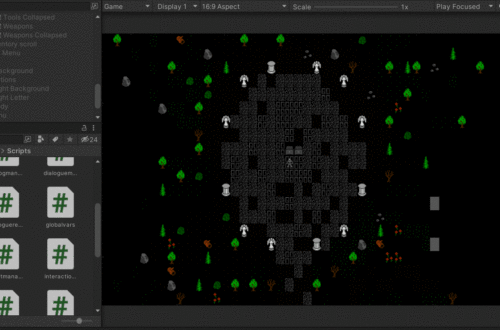
Inventory – All the Data
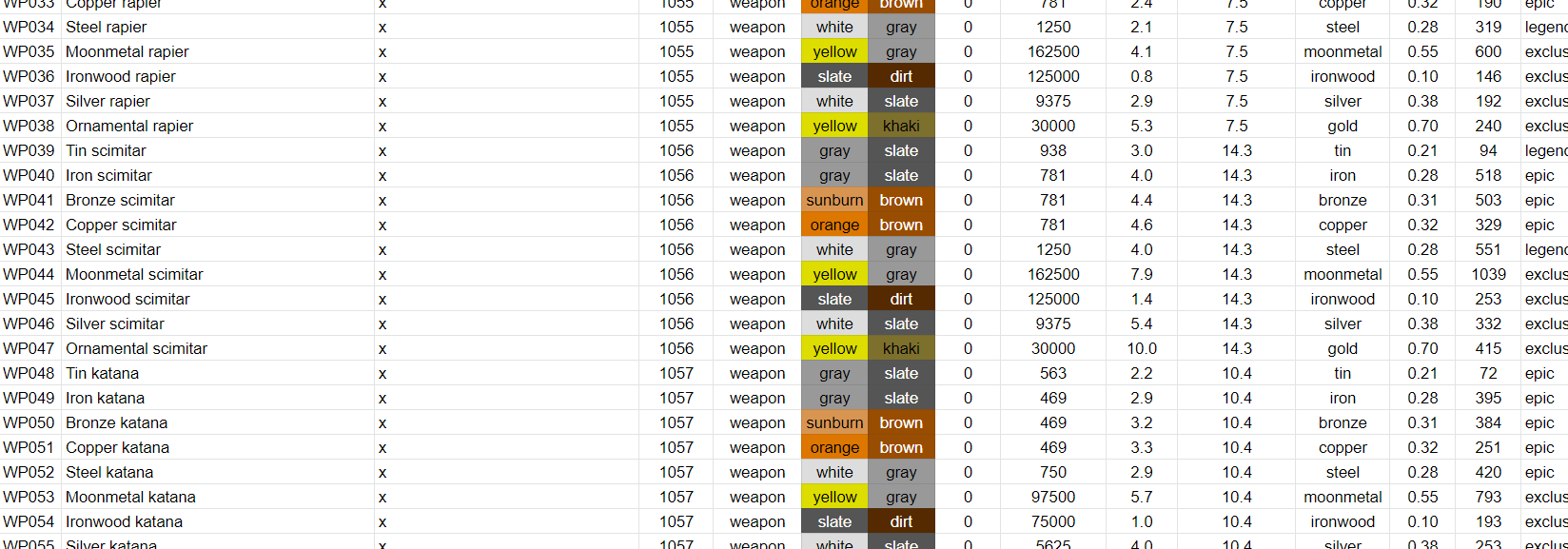
Well that took forever. I wanted to make sure that I had some test inventory items. I have 13 kinds of items and I wanted several examples from each kind so I could test things like sorting, masking, scrolling, string length, etc. So I took all the icons I had created and made at least one item for each (several for some).
This wouldn’t have taken so long (a month!) but for the fact that I needed to account for things like weight, density, and volume in preparation for my magic system’s ability to transmute things from one material to another. I can’t do things like this without being accurate, so I spent the last month building this item database while looking up things like the density of silk in pounds per cubic inch. Turns out it’s hard to get a volume for things like silk rather than just an area. And silk is stronger than hemp, so a silk rope should be made of less material than a hemp rope, right? This left me with a multivariable problem for each and every inventory item.
If that weren’t enough, I wanted to have a basic idea of economy at this point, too. We’ve all played plenty of RPGs and know that the player’s wealth gets pretty broken by the end of the game. As an adventurer, you don’t make a typical salary. But what is a typical salary and what should things be worth? I looked up some tables of real prices of medieval items just to get a reasonable baseline. But a magical medieval world will have a very different economy than a real medieval world. And even in a real medieval world, prices vary from location to location, as “exotic” items will always cost more and will depend on what’s far away and what’s local. I had to ask myself if I wanted to mimic that structure. Should item price vary by location? Probably not as that’s awfully complex for a game. And how realistic do I want prices to be? If the player finds one set of steel full plate in a chest, they should realistically be able to buy a house with that. Not very good from a game mechanics point of view. So I decided to base my prices off an established game – Dungeons and Dragons. But which version? And are prices stable between versions? And are those prices at least reasonably realistic?
All these questions led to a long process of determining item value. But even with this, I had a hard time finding many items. Sure, I could easily look up the price for a steel dagger, but what about a marble statuette? Or a single whole pineapple? Or a dagger, but one made of tin rather than steel? I had to do further research to look up the value of raw metals and what craftsmen would look for in a profit margin for various markets. This way I could get a realistic price for a steel dagger, then multiply or divide it by a factor to get a tin dagger, or a bronze dagger, or a gold dagger.
Why go to all this trouble? Because in my game it will be possible to buy a cheap tin dagger and use magic to transmute it to gold. The player could then theoretically sell that back for a massive profit, ending with a broken game economy. So the price for transmuting needed to be comparable to the price for getting the item outright. Sure, the player can make a profit, but it may be tedious to get any serious amount of wealth that way.
Finally, I needed to start thinking about loot tables as well. If I open a chest and it randomly picks from all the items I’ve created, what will that item’s average worth be? Can the player open one chest and suddenly have enough money to buy all the raw materials for a house? I needed to divide up the values of items into brackets of loot table rarity. Obviously valuable items will need to spawn a lot less often than cheap ones. And there should be enough cheap ones so that every chest doesn’t weirdly contain a loaf of bread or three. So out of all the items I created, are enough going to be cheap to prevent this? I created buckets that give the average worth of a found item to be around 10 (when sold). This comes out to roughly a day’s worth of labor from a cheap laborer for each item the player finds. So if you open a chest and get 5 items, that’s a working week’s salary for a laborer assuming you can find somewhere to sell the items. Is that reasonable? Well, it doesn’t sound horribly broken but I guess we’ll see.
Now with this all finished, I can finally import these item tables into the game and start making inventory management fully fleshed out.


You May Also Like
First goal: Rendering a map – Map indices
A sidebar with passing time